New talents in climate research: Ahmed Elberry
“What happens to the economy if we manage to reach carbon neutrality by 2050? What happens to GDP, employment, prices, welfare and trade?”
14 September 2026
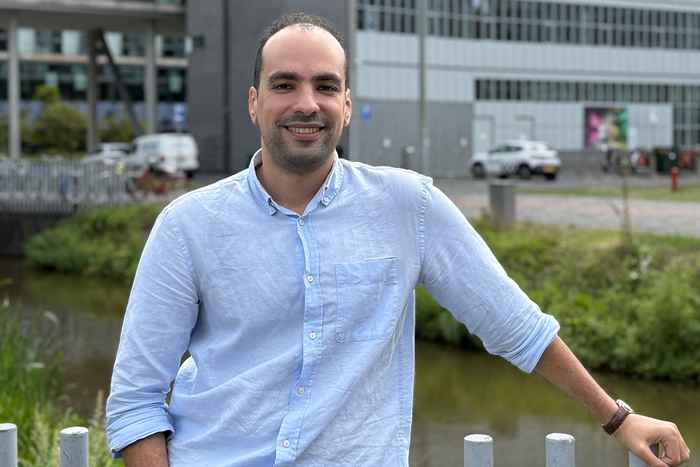
How do you measure the economic impact of carbon neutrality?
"My main research question is: if we change the way we produce and use energy, what does that mean for the macroeconomy? For example, what happens to GDP, employment, prices, welfare and trade?
Macroeconomic models cover all agents in an economy but lack engineering detail. So part of my work is about bringing more of that detail into the macroeconomic analysis through a process called soft-linking.
To understand these impacts, I use mathematical models, i.e. Computable General Equilibrium (CGE) models for the macroeconomy and energy system optimisation models for the energy system. Energy systems models have a detailed representation of technologies and associated infrastructure. Macroeconomic models cover all agents in an economy but lack engineering detail. So part of my work is about bringing more of that detail into the macroeconomic analysis through a process called soft-linking.
For example, decarbonising the steel industry requires a shift from conventional steelmaking technology, which relies heavily on coal, to alternative technologies such as DRI, which can use hydrogen. This transformation would not simply mean replacing one energy input with another. Such a shift would alter the energy mix (as each production route comes with its own combination of energy carriers) and require additional infrastructure investments. Without soft-linking the models, the macroeconomic model could overlook these implications and misrepresent important energy-system details."
Why did you choose these particular research questions?
"I have always been interested in energy system models because they show how much energy is needed, what type of energy is needed, what technologies we need, and what investment is required to meet a certain demand at the lowest possible cost, while accounting for technical and environmental constraints. But the macroeconomic side is often missing.
I enjoy the model development part the most. You start with a question, then figure out how to represent it mathematically in the model. Then you have to program it, test it, and see whether it behaves as you expect for the base year.
We need to look at what happens to the macroeconomy when we introduce all the changes involved in the energy transition. How does it affect GDP? Employment? Welfare? Prices? Trade and competitiveness? The latter, in particular, matters for countries that rely heavily on exports. So I found this connection between the energy system and the wider economy very interesting. We need to know what is technically possible and what is required to achieve the transition, while also understanding what this means for the economy as a whole."
What do you hope to achieve with your research?
"I want to improve how we represent the energy transition in macroeconomic models better to understand its potential impacts on the wider economy. Refining macroeconomic insights on the energy transition can support better policy design and economic and energy planning."
Do you also work with external partners?
"I work within the Sustainable Energy Technology group at UvA, but my project involves many different people because I work across the energy-system and macroeconomic sides. I work with researchers developing and applying the macroeconomic model at E3 Modelling, as well as people working on the energy-system modelling side at TNO.
I have also collaborated with researchers outside the UvA, including researchers at KTH Royal Institute of Technology, the Joint Research Centre of the European Commission, and the Lithuanian Energy Institute."
Which phase of the research do you find most interesting?
"I enjoy the model development part the most. You start with a question, then figure out how to represent it mathematically in the model. Then you have to program it, test it, and see whether it behaves as you expect for the base year.
The most challenging aspect of doing a PhD is defending everything—my assumptions, the technologies I modelled, and the methods I used.
Then, when you run the scenarios, you sometimes get a result you didn't expect. That's the interesting part for me, because then you have to analyse the results and understand what is driving them. Is it the policy? Is it a target that you put in the model? Is it the cost of a technology? You go back to the model and make sure that everything is correct, and if it is, you might end up with new insights into the energy transition. It can then open the door to further research, for example, through sensitivity analysis of those drivers, to narrow them down to a few key ones."
What is the most challenging aspect of the stage you’re in now?
"The most challenging aspect of doing a PhD is defending everything—my assumptions, the technologies I modelled, and the methods I used. I have to be able to stand before a panel of experts and defend all of these choices along with the results that I obtained."
What character traits are you most proud of?
"For me, it's that I never feel entitled to other people's time or help. I genuinely appreciate the people who have helped me throughout the PhD, especially those who have given me their time, helped me with my papers, read my work, given me feedback, or pointed me in the right direction."
Who is your greatest hero in science, and why?
"I don't really have one, at least not up till now. But if I had to name one, I would go with Hypatia of Alexandria, the mathematician, astronomer, and philosopher. I admire her intellectual independence, even in a very difficult political and religious environment."
Where are you heading after completing your PhD?
"I want to continue improving my mathematical programming and modelling skills. There is still a lot for me to learn about how we can further improve these models so that we can use them to answer more complex questions.
I will continue in scientific research, particularly in energy, climate, and macroeconomic modelling, at E3 Modelling, part of WSP, where I can work on both research and application. They use these models to answer concrete questions from governments and other organisations, such as the European Commission, about the economic implications of different policy options. This can then provide a better basis for developing climate and macroeconomic policies.”