New talents in climate research: Gabriella Guinlle Ferreira de Oliveira Santos
“The PhD is a funny process: I started with the naive assumption that I would finish with all the answers. What I have now is more questions, but also more certainty about the paths I need to build, which I suppose is progress, even if the finish line keeps moving.”
11 June 2026
You focused on hydrogen?
“Yes, hydrogen became one of the central bets in European industrial and climate policy precisely during the years I was researching it. I also looked at citizen initiatives challenging the incumbent energy system, where access to participation still depends on property, capital, and social position. What I found has direct implications for how European energy and industrial policy is currently being designed.”
What were your main research questions?
“Europe has committed to becoming climate-neutral by 2050, and hydrogen is being promoted as a key solution. But what hydrogen is, what it can do, and who it is for are not technical givens; they are being actively decided, contested, and sometimes deliberately left vague.
My research asks who is shaping those decisions, and what gets quietly left unresolved in the process. When supply chain choices are not made explicit, when key terms like "clean hydrogen" remain ambiguous, or when certain industries or communities are left out of the conversation, those gaps get filled by actors already embedded in existing systems.
What I found was that the initial question itself needed to be broken open. Businesses do not play a single role, nor do they act as a single entity.
Each chapter examines a different arena where that contestation plays out, from corporate documents to EU policy to local energy initiatives. These were not just research questions; they were live political and industrial battles unfolding around me as I was writing, and this research has something to say about how they are being fought and who is winning.”
Why did you choose this particular research question?
“My supervisor Ans Kolk suggested exploring the role of business in the energy transition and the trade-offs involved, and pointed to hydrogen as an emerging technology. I decided to follow it, taking a phenomenon-driven approach in which the data and the empirical setting gradually shaped the research questions.
I am disciplined enough to keep pushing and humble enough to reach out for help when I need it. I think that combination matters more in research than people admit.
What I found was that the initial question itself needed to be broken open. Businesses do not play a single role, nor do they act as a single entity. Even within the same type of actor, there is contestation. So "which businesses, doing what, under which conditions" turned out to be as important as the original question. That is the direction I chose to take.”
Which phase of the research do you find most interesting?
“When the work gets close to the real world. Whether that was interviewing people for one of the chapters or attending practitioner events to understand how hydrogen is actually discussed outside academia, those are the moments when the pieces start to connect.
That is also what I hope the research achieves: not just an academic contribution, but something useful to the people and organisations actually navigating this transition.
It is not a perfect piece, but it is honest. It shows the paths I built to get here. And now I feel prepared to defend that process.
Now I’m in the final stretch, waiting for my defence, planned for November 2026. The last task was tying the chapters into a coherent narrative in the introduction and conclusion, which turned out to be a good exercise because it forced me to step back to see what I did and try to answer the ‘so what’."
What is the most challenging aspect of this stage?
“Accepting that the thesis is the result of a process, not a reflection of where I am now. I have learned a lot and changed my mind on things; each chapter was written at a different stage, at a different pace, for a different audience. It is not a perfect piece, but it is honest. It shows the paths I built to get here. And now I feel prepared to defend that process."
Who did you work with?
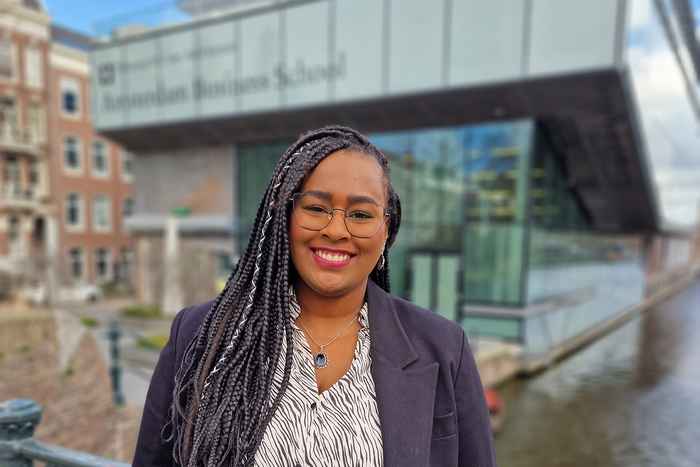
“My supervisors are Ans Kolk and Arno Kourula at the Amsterdam Business School. I collaborated with a colleague, Maurice Wokke, on the steel chapter, which involved analysing decarbonisation projects across European steel producers. I have also been working in a side project during the last months with Vittoria Scalera about aviation decarbonisation using sustainable fuel produced from waste (the ENLENS project), which brings together chemistry researchers and industry stakeholders, including the Port of Amsterdam, Schiphol, and fuel producers.
My mother always told me: "o não você já tem, então tem que tentar," which roughly translates to: the only real no is not trying, because without trying, you already know the answer.
I recently joined Erasmus University Rotterdam as a postdoc at the Erasmus Commodity and Trade Centre, where I continue working on hydrogen, now as an emerging commodity, focusing on its potential international trade routes and the role of the Amsterdam-Rotterdam-Antwerp port-industrial clusters in its market development.”
What character traits are you most proud of? And how do they help you in your field?
“Persistence and the willingness to try from multiple angles, even when something is not working. My mother always told me: "o não você já tem, então tem que tentar," which roughly translates to: the only real no is not trying, because without trying, you already know the answer. So I ask, I try, I fail sometimes, and I try differently.
I am not an expert in everything, and I do not think that is what the PhD requires. The PhD requires commitment, self-motivation, organisation, and an understanding of your limitations. I am disciplined enough to keep pushing and humble enough to reach out for help when I need it. I think that combination matters more in research than people admit.”
What would you still like to learn in the coming years?
“The PhD is a funny process: I started with the naive assumption that I would finish with all the answers. What I have now is more questions, but also more certainty about the paths I need to build, which I suppose is progress, even if the finish line keeps moving.
The research only matters if it reaches the people it is supposed to help.
I am glad I have had the chance to explore and reflect alongside people whose work I genuinely admire. There is so much more to understand: industrial policy, international markets, geopolitics, and the financial and social layers of how energy transitions actually happen. An endless list, but one I want to keep working through in ways that help me stay useful in this field.”
Who is your greatest hero in science, and why?
“My greatest heroes are in my family, not in science. But if I point to someone whose work I genuinely admire, it would be Anna Gifty Opoku-Agyeman, who is not a scientist in the traditional sense but who has a rare ability to translate complex ideas into something that connects with people outside academia. That is what I want my own work to do. The research only matters if it reaches the people it is supposed to help.”