Ways of Water – Overcoming Conflicting Sustainability Pathways in the Port of Amsterdam (WoWPoA) (2025-2027)
SEVEN theme: Climate and health
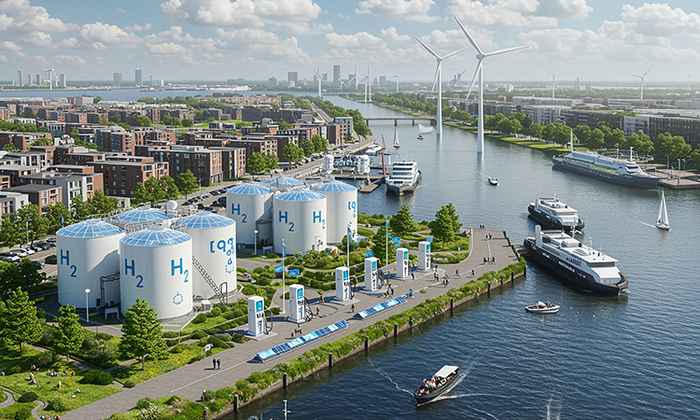
The Port of Amsterdam (PoA) is currently undergoing a major transformation, shifting from its historical role as a fossil-fuel hub towards new functions related to renewable energy, hydrogen, and circular industries. While this transition is essential for achieving climate goals and the EU Green Deal, it also generates tensions between economic development, ecological concerns, and urban development, particularly in spaces located at the port-city interface. At the same time, this transition depends upon the water system of the port-city-region, including canals, waterways, locks, quay walls, and infrastructures that enable logistics, industrial activities, and ecological processes.
Starting from the PoA water system and its surrounding territory, the WoWPoA project investigates how sustainability transitions unfold within the complex port-city-region water system, understood as both a logistical network and an ecological system. In this context, water is not only a medium for transport and economic flows, but also a critical element shaping environmental quality, spatial development, and everyday urban life.
How the energy transition (re)configures relationships with the water system
The project examines how social actors, governance arrangements, and physical water-based and industrial infrastructures interact to shape sustainability pathways in the port-city-region. Particular attention is paid to how power relations among PoA’s waterway stakeholders, existing industries and infrastructure, and long-standing institutional arrangements create path dependencies that influence the strategies and pace of the energy transition. It also explores how the energy transition (re)configures relationships with the water system, for instance, through new energy carriers (e.g. hydrogen), changing logistics, and emerging pressures on water quality and ecological conditions.
Using the PoA as a case study, the project combines qualitative interviews, stakeholder engagement, and participatory workshop methods with actors from the port authority, municipality, industry, water management institutions, and civil society. These collaborative processes aim to develop: (i) A shared vision for the future of the port-city-region and its water system, reflecting diverse stakeholder perspectives; (ii) Conceptual models that reflect the current dynamics of the port-city ecosystem, including key economic, ecological, and infrastructural interactions; (iii) Identification of leverage points that can support collective action, governance innovation, and more balanced sustainability outcomes.
By bringing together academic research and stakeholder dialogue, WoWPoA seeks to support more integrated and adaptive approaches to governing transitions in port-city-regions, advancing just and sustainable waterway development in the PoA while balancing economic prosperity with ecological resilience and urban liveability.
-
Envisaged Impact
WoWPoA delivers both scientific and societal impact. Scientifically, it advances conceptual and methodological approaches to studying sustainability transitions in the complex water system of the port-city-region of Amsterdam, bridging urban metabolism and governance perspectives. It produces new insights into how conflicting objectives and strategies can be aligned across sectors and scales. Societally, the project supports the Port of Amsterdam and its stakeholders in moving beyond fragmented, sector-based decision-making toward coordinated and just sustainability strategies. Its findings directly inform policy and planning under frameworks such as the Omgevingswet and contribute to Amsterdam’s ambition to become a climate-neutral and circular city. Furthermore, beyond Amsterdam, WoWPoA generates transferable knowledge for other port-city-regions facing similar challenges, contributing to European and global debates on sustainable port development and urban transitions.
-
Researchers & partners
The project is a collaboration between IBED (Dr. Elisabeth Krueger), the Urban Planning group at GPIO-FMG (Dr. Jannes Willems, Prof. Maria Kaika), the Faculty of Economics and Business (FEB, Dr. Mark van der Veen), and the Faculty of Law (FdR, Prof. Margaretha Wewerinke-Singh). The work is led by Dr. Mina Akhavan (UVA, Urban Planning group at GPIO); former PostDoc: Felipe Ancapi Bucci.
-
Funding
Funding for this project comes from UvA’s Sustainability Platform (IP Theme Sustainable Prosperity).
-
Opportunities for collaboration
Do you see an opportunity for yourself or your organisation to collaborate on this theme? Please contact Mina Akhavan (m.akhavan@uva.nl)