Co-creation and Integration of Planetary Health Impact Assessment in policy practice (CINPHIA) (2026-2031)
SEVEN theme: Climate and Health
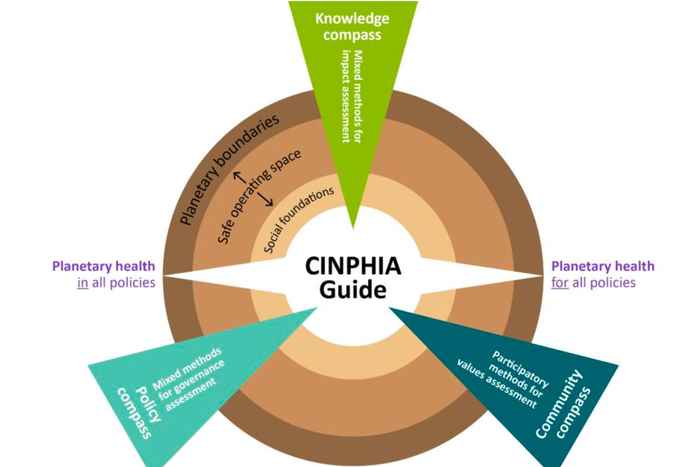
With an NWO/NWA grant, Co-creation and Integration of Planetary Health Impact Assessment in policy practice (CINPHIA) will spend the next five years developing a Planetary Health Impact Assessment Guide to support policymaking in the protection and restoration of planetary life support systems and the health of people and the environment.
The health of people and that of the planet are inextricably linked. Both are under pressure due to, among other things, climate change, environmental pollution, and biodiversity loss. Planetary health is about understanding and addressing human disruptions to Earth's natural systems to support the sustainable health of humans and all life on Earth. However, policymakers lack a clear overview of knowledge and evidence to account for planetary health impacts in policy practice. Citizens and other groups assign different meanings to these concepts, and responsibilities are scattered across various ministries, sectors, and levels of government. It is still not well understood how we can facilitate collaborative and integrated policymaking.
The goals of CINPHIA are therefore to:
- clarify the concepts of planetary health and integrated policymaking;
- develop an instrument, the so-called ‘Planetary Health Compass’, to support decision-making;
- gain insight into the distribution of effects across different regions.
CINPHIA is a transdisciplinary project that brings together a collective of diverse knowledge institutions and disciplines, relevant ministries, provinces and municipalities, implementing organizations, and citizens; thereby directly aligning with the needs, capacity, rules, and conditions of these stakeholders. An early version of the Planetary Impact Assessment Guide will be tested in two distinct case studies on (1) the impacts of climate policy on potential effects on infectious diseases, and (2) the impacts of sustainable pharmaceuticals policy on the environment.
-
Envisaged impact
We aim to achieve four interlinked impacts:
Impact 1: Policy Integration and institutional change, facilitated through the Policy Compass which provides systemic procedure identifying for each stage in the policy or regulatory process, the purpose, strategies, appropriate methods for intersectoral and multilevel governance of planetary health “in all and for all policies”.
Impact 2: Knowledge Integration and normalization of planetary health considerations, supported by the Knowledge Compass, which offers a systematic approach for identifying, for each stage in impact assessment, the appropriate approaches from rapid appraisal and stakeholder consultation to quantitative scenario modelling, thereby embedded planetary health in standard policy analysis and assessment routines.
Impact 3: Improved policy acceptance, implementation, and compliance, facilitated by the Community Compass and achieved through co-creation, transparency, and participatory validation processes that engage stakeholders from policy, civil society, industry, and executive agencies, ensuring that Planetary Health policies are context-sensitive, feasible, and widely supported.
Together impact 1, 2 and 3 lead to Impact 4: Improved planetary health outcomes through policies that reduce environmental degradation, protect ecosystem services, and promote equitable human health within planetary boundaries.
-
Researchers and partners
The project is coordinated by Dr. Marleen Bekker PhD (PI, WP5-6 Lead), Associate Professor of planetary health policy and governance in the Health and Society Group at Wageningen University and Research.
SEVEN researchers involved are Anniek de Ruijter (WP1 Lead), Law Centre for Health and Life (Amsterdam Law School) and from the Institute of Biodiversity and Ecosystem Dynamics (Faculty of Science) Antonia Praetorius (WP4 Lead) and Lies Jacobs.
-
Funding
The project is funded by the Dutch Research Council (NWO) under the Dutch Research Agenda (NWA) programme “Building blocks for integrated policy on Planetary Health”.
-
Opportunities for collaboration
Do you see an opportunity for yourself or your organisation to collaborate on this theme? Please contact Denise Li.