New talents in climate research: Maroesjka Verhagen
'We can now buy strawberries in the supermarket all year round, but how (and why) did they end up there? The roots of this lie in the seventeenth and eighteenth centuries.’
31 March 2026
Are you looking specifically at the influence of the seasons on dietary patterns in Amsterdam at that time?
‘Yes, in my research I ask how Amsterdammers navigated the seasons in their early modern food supply. I sometimes put it like this: we can now buy strawberries in the supermarket all year round, but how (and why) did they end up there? The roots of this lie in the seventeenth and eighteenth centuries. In each chapter of my thesis – working title ‘Navigating the Seasons. Amsterdam’s Early Modern Food Provision’ – I address this question by focusing on a food group that was strongly represented in that season: spring/vegetables, summer/fruit, autumn/beef, winter/preserved food.’
Are you the first historian to give the seasons such a prominent role?
‘Seasonality has always been mentioned in food history research and identified as important; for instance, it has often been noted that autumn was a key harvest time for grain. Yet it subsequently plays only a background role. The seasons and how people dealt with them thus took on a static character, whereas I saw in the sources that they preoccupied early modern people continuously: the year was structured around this cyclical rhythm, and in the meantime, adjustments were made to the food supply to reduce dependence on that rhythm.’
What do you hope to achieve with your research?
‘I hope that readers of my research will be encouraged to reflect on humanity’s entanglement with the environment – in this case, regarding the influence of the seasons on our food. Firstly, I wish to demonstrate how formative the seasons were in the early modern period as an organising principle: people structured their year around the seasons and had to plan for winter, a general time of scarcity.
The average Amsterdammer in the early modern period was very conscious of their relationship with the environment because it was essential for survival. We cannot, therefore, view the past in isolation from that cyclical rhythm. Studying food history through a seasonal lens thus yields new insights. For instance, little is known about the role of housekeepers in storing and preserving food, yet this was crucial work, dependent on knowledge and skills without which people could not survive the winter.
At the same time, in the early modern period, people also found increasing scope to manoeuvre within that seasonal cycle. Ways were found to ‘stretch’ the food seasons, for example, using hotbed techniques. But also the professionalisation of storage and preservation techniques meant that more and more food could be eaten out of season.
Here, then, lie the foundations of where we find ourselves today: in an era in which, in a country like the Netherlands, we can theoretically serve the same dishes every week of the year. We also find ourselves in an era in which city children need school gardens and trips to farms to understand what food is and where it comes from, and some adults are actively seeking to ‘live in tune with the rhythm of the seasons’; a time in which we see that balance is needed in the cultivation of our natural environment, that monoculture comes at a price, and that agriculture as we knew it is in need of change.
I also believe it is important to present the nuanced story I encountered in my research: that ‘disconnection’ from the seasons cannot be explained solely through mechanistic or capitalist thinking, in which nature can be subjugated for personal gain. There were everyday challenges that drove such developments, such as the exponentially growing population that needed to be fed.
With urban expansion, the city’s hinterland shifted further and further out, meaning that production became increasingly specialised in the periphery. If, as a city dweller, you then feel less and less dependent on your surroundings, mechanistic and capitalist thinking find more fertile ground in which to take root.
I find Timothy Snyder’s works On Tyranny and On Freedom, and his political commentaries on Substack, skilfully and courageously written, and powerfully substantiated – full of nuance yet crystal clear about the truth. To me, he is a fine example of how valuable historians can be in building the future.
Food thus became increasingly accessible, but at the expense of that conscious seasonal connection. I think this knowledge can help us build the future. Incidentally, I don’t have any concrete ideas yet about how to implement this, but as always when building solutions, recognising a challenge is the first step.’
Who is your greatest hero in the world of science, and why?
‘There are several historians (and philosophers) whose work I find deeply inspiring. Take, for example, the cultural historian Johan Huizinga, whose writing style and ideas about ‘historical sensation’ have fascinated me since my bachelor’s in History. Carlo Ginzburg’s The Cheese and the Worms is another such example. My attention is often captured by works that give voice to people—and more-than-humans—from the early modern past, voices that might otherwise go unheard, or that render the invisible visible. Executing such work requires both originality and courage.
I also think of scholars like Erica Fudge, Marcy Norton, and Thomas Almeroth-Williams, who explore animal-human histories, and Pamela Smith, who embraces reconstruction as a method (and whose research provided me with tools to make early modern cheese during my Research Master’s). I’m also fortunate to have supervisors like Danielle van den Heuvel and Djoeke van Netten, both of whom are familiar with the quest to uncover the less visible past.
Ultimately, I found much support for my perspective on the past (and the world in general) in the work of Bruno Latour and other neo-materialists like Donna Haraway: a world existing in constant interaction, where agency, though unevenly distributed, can be discovered everywhere. This has fueled my interest in environmentally focused and more-than-human approaches, with the works of environmental historians such as William Cronon, Donald Worster, and Karl Appuhn being particularly influential.
Finally, I would like to mention someone whose more academic work I am actually not very familiar with, but whose more public work I greatly admire, namely Timothy Snyder.
I find Timothy Snyder’s works *On Tyranny* and *On Freedom*, and his political commentaries on Substack, skilfully and courageously written, and powerfully substantiated – full of nuance yet crystal clear about the truth. To me, he is a fine example of how valuable historians can be in building the future.’
Which phase of the research do you find most interesting?
‘I find the rewriting phase, which I am currently in, a very enjoyable and interesting stage, because everything is increasingly falling into place. It’s really coming together now, as a story from A to Z, where I get to connect all that material and all those ideas from the past few years, place them within a suitable structure, and play with the right phrasing. It can involve a lot of searching, but it makes me enthusiastic.
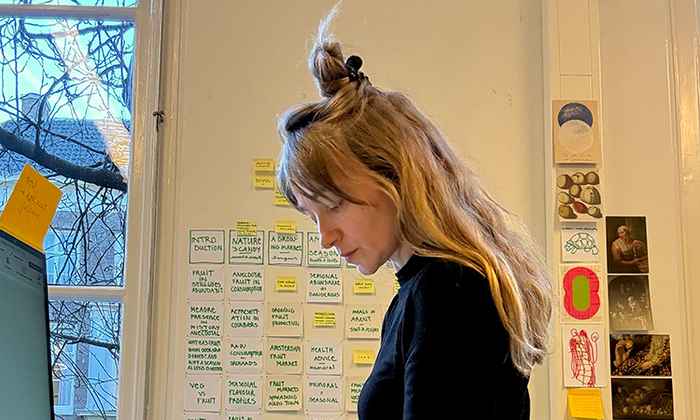
I also write a lot by hand to organise my thoughts, and I use notes on my wall to relate to the structure in a more physical way. Walking around and moving with my laptop to different locations also helps me.
The hardest part of this phase is starting the rewriting of a chapter. That’s when I have to find my way through the material and ideas from sometimes years ago. Especially when you’ve just finished a chapter, it feels like quite a speed bump. It can be difficult to motivate myself then, but the complicated yet wonderful thing about writing a dissertation is that you’re confronted with yourself so often that you simply have to learn to deal with those kinds of challenges.
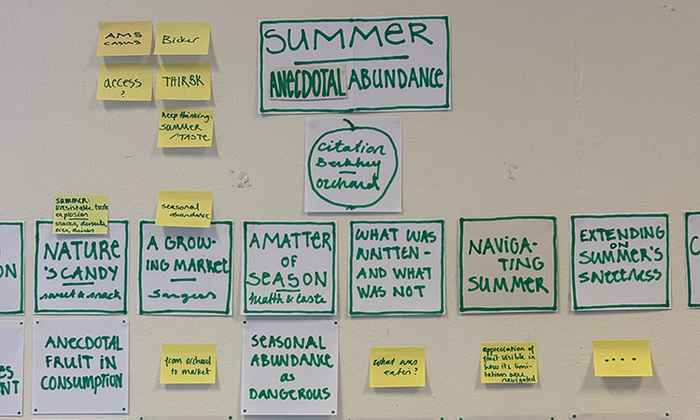
I’m now getting better at accepting that, for me, those moments of work require a different gear, with a different approach. It helps me to first ‘hover over’ the text rather than diving straight into rewriting. I fill in an argumentation schema, sketch out the structure, and then cut and paste old drafts into it. I also write a lot by hand to organise my thoughts, and I use sticky notes on my wall to relate to the structure in a more physical way. Walking around and moving with my laptop to a different location also helps me.’
Which character traits are you most proud of?
‘I think I’m most proud of my enthusiasm, creativity and perseverance, because without those traits I would never have been able to write this dissertation.
But what I’m happiest about is my newly developed capacity for acceptance: accepting the fact that everyone has their own process and that you can learn to trust your own, even when things aren’t going quite as you’d expected. I’ve been able to develop that capacity whilst writing this dissertation, and I want to keep practising it, because it makes everything lighter and more enjoyable, and more productive.’
Ideally, I’d like to introduce a more material component into my work. I have a background in autonomous art (Rietveld Academy), and I miss the more physical relationship with my work.
What else do you want to learn in the coming years?
'Ideally, I would like to introduce a more material component into my work. I have a background in autonomous art (Rietveld Academy), and I miss the more physical relationship with my work. I hope to practise finding a suitable form in the coming years. Perhaps I would like to try working in a more museum-like context or incorporate a reconstruction component into my research. It could also mean that I want to find more space for my creative work alongside research and writing. Furthermore, after this solitary project, I would also like to work with others on a project and thus learn more through collaboration.’
What are your plans after completing your PhD?
'First, I’m going to travel through the Italian Alps with my husband and four-year-old daughter to celebrate the completion and make room for what’s next. I’ve secured a postdoc for September, in which I’ll continue with the seasonal theme; this time in the context of light. Exactly where I’ll be doing that is still a secret for now.’