New Talents in Climate Research: Charissa Leiwakabessy
“The moment you enter someone’s home, the energy transition ceases to be only a technical issue; it becomes a social one as well.”
23 March 2026
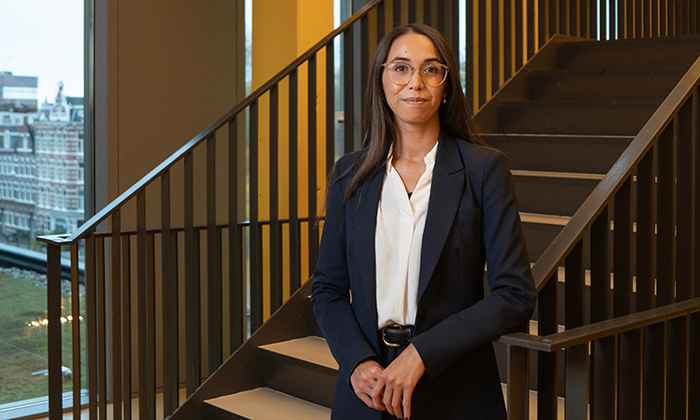
What is your central research question?
“My research as a PhD candidate in Political Science, particularly within the Just Prepare project, a NWO-KIC-funded research consortium, sits at the intersection of justice and energy transitions. I study this in neighbourhoods where deteriorating housing, socio-economic precarity, and eroded institutional trust have accumulated over years, if not decades. I focus on two cities: Rotterdam and Amsterdam.
Both have been designated as priority sites for early transition, partly because their deteriorating housing stock is seen as offering quick wins in emission reduction. The central question I ask is about recognition: whose experiences, needs, and forms of knowledge become visible within these energy renovation processes, and whose do not, and how so.”
Recognition of what exactly?
“There is a mismatch between residents in underprivileged neighborhoods and the actors planning and implementing energy renovation solutions. My research asks what lies underneath that mismatch — specifically, what happens to residents' claims and standing inside the processes designed to bridge it. Because even where participation is formally present, recognition isn't guaranteed.
People end up watching how their most urgent and longstanding issues need to make way again for a transition designed around goals that are not theirs.
Part of what makes this mismatch so persistent is that energy policy is designed around a specific, bounded problem: reducing carbon emissions. That logic is self-contained, measurable, and serves a technical objective. But these transitions currently land in neighbourhoods that are shaped by decades of deferred maintenance, financial precarity, and eroded trust. The moment you enter someone’s home, the energy transition ceases to be only a technical issue; it becomes a social one as well
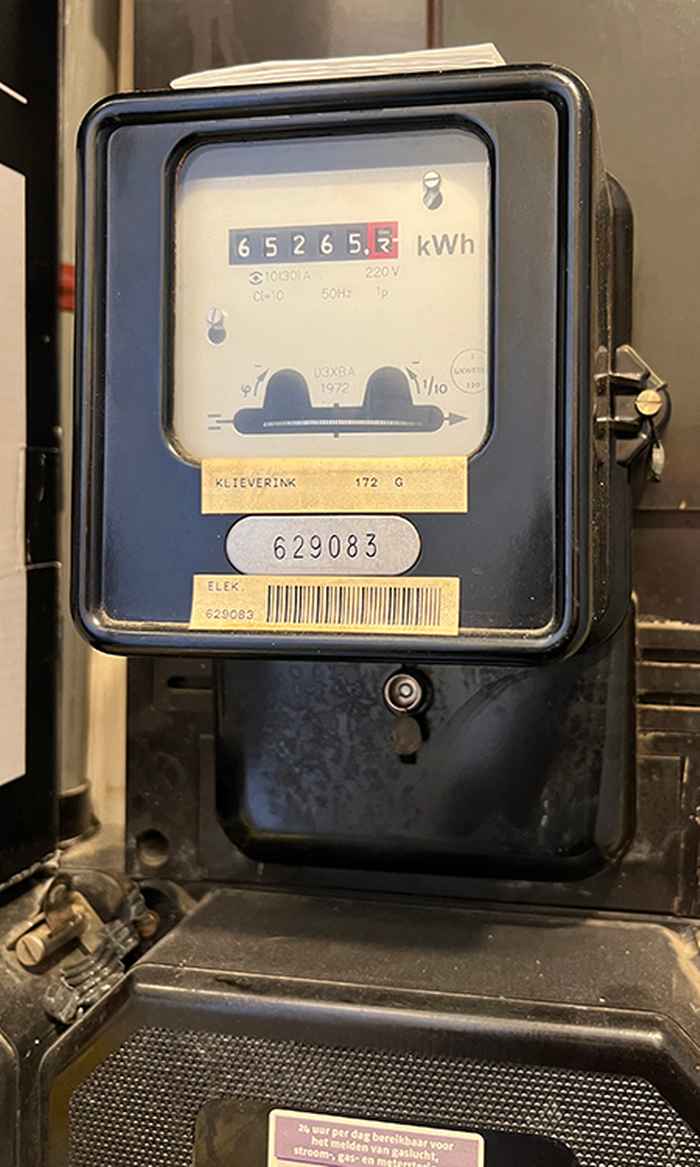
For many residents, these plans do not trigger concerns primarily about sustainability. What I have seen and heard during my fieldwork is that residents often talk about whether this time anyone will address what has been wrong with their home and neighbourhood for years, think of damp that keeps coming back, mould, heating that was never adequate, overdue repairs, broader concerns about safety, parents who are concerned about the well-being of their children, the lack of green spaces. Just to name a few. The energy transition arrives with its own agenda, and that agenda rarely has room for those other concerns. People end up watching as their most urgent and longstanding issues make way again for a transition designed around goals that are not theirs.
Many of these issues have remained hidden behind closed doors, until now – when professionals need to enter people’s homes in order to deliver the transition successfully. And even when such issues surface, there is still a risk that these issues will not be seen as evidence of something structural, something patterned, something that asks for a response. My research asks why that mismatch, this misrecognition of residents, persists even when the institutions involved are genuinely trying to address it.”
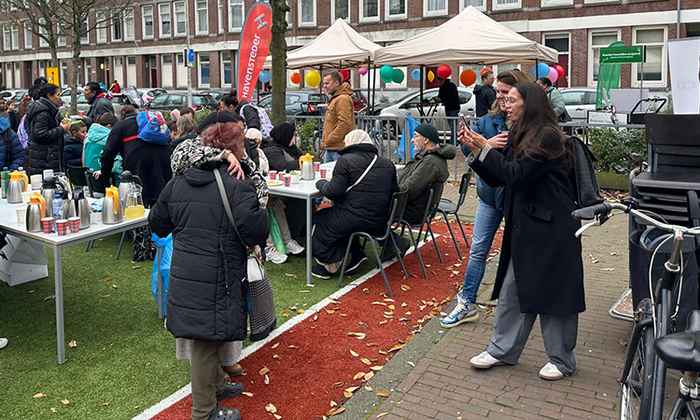
What brought you to the issue of recognition?
“When I first encountered the notion of recognition in energy justice scholarship, it was – at the time - loosely defined as an acknowledgement of diverse identities, cultures, histories, needs, and ways of knowing. Decolonial scholars, such as Coulthard and Fanon, had already complicated this view. Recognition, they argued, can also operate as a tool of containment, in which acknowledgement serves to absorb a claim without ever redistributing power or altering institutional priorities.
I encountered professionals who openly admitted they did not know how to involve residents in any meaningful sense.
Early fieldwork gave me the paradox that made that tension even more tangible. I encountered professionals who openly admitted they did not know how to involve residents in any meaningful sense, who acknowledged that technical assessments and performance targets were driving decisions in ways that displaced the lived experience of the people those decisions affected, and who acknowledged, in the same breath, that ignoring those experiences was a problem, but one they could not solve and did not even know how to. The awareness was there. The willingness was there, in many cases. And yet the pattern held.
Existing analytical tools were well-suited to identifying whether recognition was present or absent, and to evaluating the design of participation processes. They were not designed to trace how a paradox like this one, knowing and still not being able to act differently, unfolds in practice, or to explain why it persists. This puzzle led me to develop a new methodological framework, together with John Grin, my main supervisor, and Imrat Verhoeven, one of my co-promoters, an interpretive framework that traces how recognition and misrecognition unfold in practice over time. That is how the question came into being.”
What do you hope to achieve with your research?
“That’s simple to say and harder to do: to make smaller-scale testimonies of injustice harder to dismiss. Most frameworks through which energy transitions are currently governed make certain things very difficult to see, even for people who are genuinely trying. In practice, what counts as a legitimate problem often has to fit the policy logic in which concerns related to energy are identified as addressable, while everything else is categorised as beyond mandate.
What gets seen as a problem is often seen through the lens of those doing the transition, think of residents who must be reached, targets that must be met, and costs that must not exceed what residents currently pay. These are not unreasonable goals. But they are the goals of the transition, not necessarily the goals of the people affected by and living through it.
What I hope this research achieves is simple to say and harder to do: to make smaller-scale testimonies of injustice harder to dismiss.
In the broader energy justice scholarship, attention has rightly focused on evaluative outcomes: the wrong people benefiting, critical voices excluded from formal participation. All true. All legitimate. And it remains important to keep investing in that. But my research, in line with others, suggests these are problem-outcomes, and that the problem-origin often sits somewhere else, in how a situation is set up and in whose knowledge, whose experiences get to count as relevant. But this part of the equation must also be investigated, because these are choices, often unexamined ones, that become embedded in organisational routines.
So, I hope my research can offer, at least as a start, a vocabulary for naming what is happening, so that these choices become visible, and that the question of what to do about them becomes harder to avoid.”
Which phase of your research do you find most interesting?
“The moment when the material refuses the interpretation I had prepared for it. I went into this research with a fairly clear sense of what I would find and how it would fit together analytically. Fieldwork repeatedly unsettled that, but not dramatically, and rarely through a single incident, but incrementally, through an accumulation of observations that did not quite fit the frame I had brought to them.
Over time,I learned to let go of control in a way, and trust the process enough to stop needing to know the big picture. To stay with a question before reaching for an answer.
In the beginning, this feels unsettling, unstable, almost. However, throughout the process, you become aware that the friction between what the theory says and what the situation shows you is where the most demanding thinking happens. I did not begin this PhD with the tolerance for that kind of open-endedness. I had to grow into it, and I consider it one of the most important things I have learned – and thereby also one of the most interesting aspects of doing this type of research.”
Who is your greatest hero in science, and why?
“The ones that came before me, particularly those working in critical scholarly traditions. It is a broad and varied terrain, including (but certainly not limited to): decolonial, feminist, queer, indigenous, and critical policy studies. These fields exposed me to diverse ways of knowing, tools, methods, frameworks and in a way, the confidence to question prevailing epistemic logics, to ask not just what institutions see, but what underlying conditions shape what they can see in the first place.
And then there is interpretivism, passed down by my supervisors John Grin, Imrat Verhoeven, and Stan Majoor. I think of them as my leermeesters, a Dutch word that captures something richer than supervisor or mentor, closer to apprenticeship, where you learn by working alongside someone while slowly finding your own craftsmanship. They not only give me methods. They gave me a way of seeing, a set of convictions about what knowledge is and where it comes from, and from that, the tools to trace and systematically analyse the meaning-making processes I study.
What I most want to honour is the cost at which many of these bodies of knowledge were produced. Some scholars in these traditions built their arguments from the margins of academia; sometimes their works were met with resistance or dismissal, and sometimes it took a while before these bodies of work were taken seriously. I would not be asking the questions I ask without any of them.”
What character traits are you most proud of?
“What I am most proud of, looking back, is that I learned to sit comfortably amid uncertainty. That did not come naturally. Early in the PhD, I kept trying to get a complete overview of what I was studying before I felt I had the material to justify it. I mapped everything out in advance, trying to harmonise the parts into a whole before I understood what the whole was.
Over time,I learned to let go of control in a way and trust the process enough to stop needing to know the big picture. To stay with a question before reaching for an answer. That shift, from trying to master the uncertainty to learning to work inside it, is probably one of the most valuable traits this PhD gave, one that I will try to cultivate even more.”
What would you still like to learn in the coming years?
“Sitting down to listen, not because you want to respond, but to understand, to provide a safe space for stories to emerge, sometimes these are complex stories, emotional ones, stories about distrust, neglect, frustration, but also stories about hope, resilience, and even transformation. In that event, you become a witness to a living and embodied history narrated by the person in front of you.
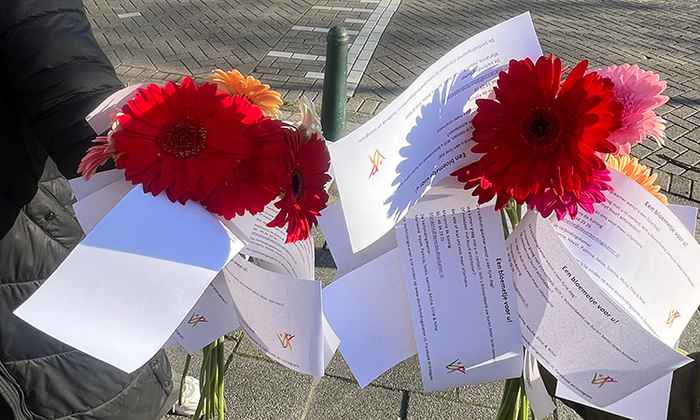
This dynamic, the connection between the listener and the storyteller, is something I would like to explore further, especially in relation to the question: whose experiences, whose needs, and whose knowledge become visible and acted upon?”