The ICJ Set the Bar, COP30 Walked Around It
In conversation with SEVEN’s André Nollkaemper
24 November 2025
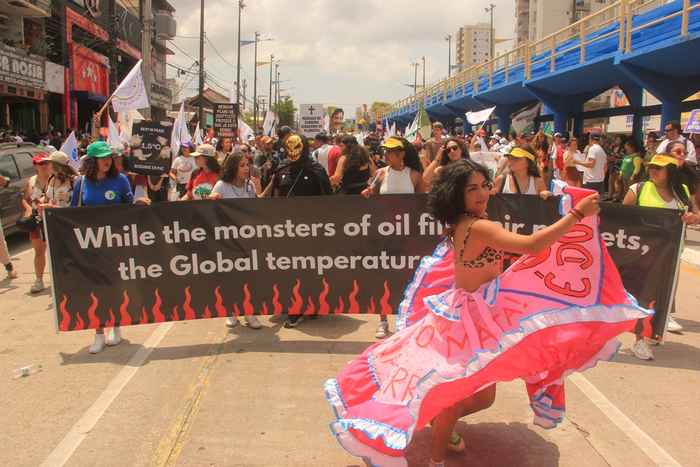
Before COP30 began, many observers said the ICJ Advisory Opinion had fundamentally shifted the legal landscape. How did that shape your expectations for COP30?
The Advisory Opinion has indeed reshaped the terrain of climate governance, offering clarifications that significantly strengthen and refine the legal framework guiding global climate action. There was so much uncertainty and disagreement on what international law actually demanded that the Opinion reads almost like the articulation of a new, more coherent set of duties.
Moreover, in certain areas, the Court advanced the law, in particular its reaffirmation that 1.5°C is the primary temperature goal of the Paris Agreement, its clarification that the National Determined Contributions (NDCs) are binding obligations of conduct rather than voluntary political gestures, its handrails for the obligation to cooperate, and its emphasis that developed countries must provide climate finance at a level consistent with achieving the Paris Agreement’s objectives.
COP30 was a missed opportunity to speed up implementation of the obligations as clarified by the Court, but real progress can continue outside the COPs.
Admittedly, the Court did not explicitly speak to the COP. The General Assembly had asked it to clarify the legal obligations of states, not those of international institutions like the COP. The Court stayed within that mandate. But the logic of the Opinion makes it impossible to treat the COP as somehow outside the scope of the obligations articulated by the Court. The duty to cooperate, as articulated by the Court, cannot but have implications for what states do in the COP: states must “continuously develop, maintain and implement a collective climate policy” grounded in equity and common but differentiated responsibilities. That is precisely what states are expected to do when they gather at a COP. So, going into Belém, the question was whether states acting in the COP would act on this new legal reality.
Did the COP respond to the directions provided by the Court?
No, not really, it engaged only minimally with the Court’s guidance. Admittedly, implementing climate change obligations is a long game, and no one could have expected full compliance with all obligations in Belém. But it is fair to say that COP30 was a missed opportunity to speed up the implementation of the obligations as clarified by the Court.
It is striking that the Belém Mutirão text does not refer to the Advisory Opinion. Leading up to the COP, many had called for the COP to give effect to the Advisory Opinion. For instance, Vanuatu called for the text on loss and damage to reflect the Advisory Opinion’s language on accountability and reparations. But oil-producing states opposed this and the final text ignores the Advisory Opinion.
Of course, the text contains ample references to the Paris Agreement. But there is very little in the text that reflects a recognition of legal obligation and accountability beyond the law as it was understood before the Opinion.
What may explain this silence on the Advisory Opinion?
There are several possible answers. One is that, in particular, the oil-producing states wanted to keep their hands free, unconstrained by the obligations that the Court had articulated. The COP positioned itself as a political body, making political trade-offs and consciously distancing itself from questions of legal obligation and accountability. And these trade-offs are dictated by economic and political interests that are at odds with the principles recognised in the Opinion.
The silence may also be seen as a backlash. Some commentators have rightly suggested that, on some points, the Court’s pronouncements may have gone beyond what states had agreed to. The lack of engagement with the Advisory Opinion in Belém may be seen as an implicit pushback against the Court’s assertiveness.
Another part of the explanation may be the fragmented nature of climate governance. The Court based its Opinion on a large set of interconnected international obligations. But the COP interprets its authority narrowly, limited to the UNFCCC and the Paris Agreement – as if there were no international obligations relevant to the COP outside these two documents. Even if it had given fuller recognition to the Court’s interpretation of the UNFCCC and the Paris Agreement, within this narrow understanding of its mandate, it could have engaged with only a small part of the Court’s statement of international climate law.
One of the clearest parts of the Advisory Opinion concerned NDCs. How did Belém respond to that?
On this point, the contrast between the Opinion and COP outcome is particularly glaring. The Court’s findings on NDCs are among the most important parts of its Opinion, in particular its recognition that NDCs must reflect the highest possible ambition, become more demanding over time, and – when taken together – be capable of keeping the world on track for 1.5°C. The Opinion turns NDCs, which were often seen as mere voluntary policy instruments, into a form of legal obligation.
The states in Belém didn’t recognise any of that legal reasoning. Shortly before the COP, the UN released its NDC synthesis report that found that the latest round of NDCs fell “drastically short” of the 60% cut needed to keep 1.5 °C in sight. Nothing that happened in Belém suggests that states felt they were legally obliged, under the sanction of international responsibility, to suddenly speed up the submission of demanding NDCs. The COP encouraged more NDCs but did nothing to ensure they align with the Court’s legal standards.
It is striking that the Belém Mutirão text makes no reference whatsoever to the Advisory Opinion. This silence is surprising, because states were negotiating in full knowledge that the Court had just clarified the legal parameters of their behaviour.
The biggest disappointment for many was the failure to secure new fossil fuel promises. How do you see that in light of the Advisory Opinion?
The outcome on fossil fuels in Belém was the clearest sign that the COP process did not recognize and act on the Court’s pronouncements on legal obligations and urgency. The final text contains no reference to phasing out fossil fuels, and even the modest proposal for a roadmap – supported by eighty countries – was deleted.
Of course, the COP silence does not alter states’ legal obligations. Whether the COP reaches consensus on a phase-out is irrelevant to the law. The obligations remain the same.
But a serious engagement with international legal obligations should have led to a different outcome. Reading the Advisory Opinion, it is hard to see how states could fulfil these obligations without phasing out fossil fuels. The Court made it clear that the duty to protect the climate system applies to all activities contributing to greenhouse gas emissions, including the production, licensing, and subsidising of fossil fuels. It also reaffirmed the 1.5°C limit as the legally relevant benchmark and reinforced the requirement that NDCs collectively must be capable of achieving it. Given the overwhelming scientific evidence, there is simply no plausible interpretation of those duties compatible with the indefinite continuation of fossil fuel production.
Given the overwhelming scientific evidence, there is simply no plausible interpretation of those duties that is compatible with an indefinite continuation of fossil fuel production.
Because all states must move in this direction, coordination is indispensable. A fossil fuel phase-out, by its nature, requires coordinated planning, sequencing, and burden-sharing. No country can manage the transition alone, and unilateral moves risk political backlash, carbon leakage, or simply insufficient impact. The COP would have been the natural venue for structuring this cooperation. It is the only forum where producers and consumers, large emitters and vulnerable nations, can negotiate the timelines and financial measures needed for an orderly exit from fossil fuels. In Belém, that collaborative function failed, and the coordination required to perform the obligations formulated by the Court is further pushed into the future.
The support from 24 countries for a “Belém Declaration on the Just Transition Away from Fossil Fuels” and for the first international conference on transitioning away from fossil fuels, to be hosted by Colombia and the Netherlands in April 2026, indicates that there is some momentum around the COP process. But the fact that none of the world’s major economies—apart from Europe—joined this initiative suggests that states' political will to cooperate in meeting the core obligations the ICJ has clarified remains limited.
Agriculture is another major source of emissions, but often politically sensitive. Did Belém move the needle there?
While the Advisory Opinion says very little about agriculture, all emission-producing activities fall under states’ obligations. That includes agricultural production, land-use change, and livestock emissions. Just as it is difficult to see how states could fulfil their obligations under the Advisory Opinion without phasing out fossil fuels, it is equally difficult to do so without far-reaching adjustments to agricultural policy.
Remarkably, the outcome document says nothing about, for instance, the need to change the production and consumption of meat. The True Animal Protein Price Coalition, which I chair, succeeded in securing 28 states' signatories to the Belém Declaration on GHG Emission Pricing in the Agri-Food Sector. This document calls for a ‘transitioning away’ from animal protein overconsumption by implementing greenhouse gas emission pricing mechanisms in agri-food systems and using part of the revenue to finance the Loss and Damage Fund. This is a good beginning toward what is eventually inevitable, but of course, support from 28 states is a far cry from what is needed to really cut emissions from this sector. There were no signs that the states felt that they were negotiating on the climate effects of agriculture and food production in the shadow of the law as clarified by the Court.
The ICJ’s Advisory Opinion also set out detailed obligations on adaptation. How does that compare to what the COP30 Mutirão text delivered?
Here, the outcome is somewhat better aligned with the Advisory Opinion. The ICJ made clear that adaptation is not an optional add-on to climate action and clarified the obligations to formulate, implement, publish and update national and regional programmes for adequate adaptation. It also reaffirmed that developed states have a binding duty to assist developing countries with the costs of adaptation.
The COP30 Mutirão outcome definitely offers some progress towards meeting these legal requirements. States agreed on a set of global adaptation indicators to monitor resilience and vulnerability – perhaps less ambitious than many would have wanted, but this is the type of coordination that is asked for by the international obligation of cooperation spelt out by the Court.
Also the agreement to triple adaptation finance to USD 120 billion per year by 2035 is significant. Though the language (‘calling for efforts to at least triple adaptation finance by 2035’ and ‘urging developed country Parties to increase the trajectory of their collective provision of climate finance’ is softer than the obligations articulated by the Court, this moves the needle in the right direction.
With procedural frustrations mounting, did the COP recognise the need for more effective international cooperation?
There is growing recognition that the COPs are unable to produce the type of collective action required by the international obligation of cooperation and the objectives of the Paris Agreement. Above all, the process is too fragmented and disconnected from the many other fora relevant to climate change outside the COP. Moreover, the agenda is too cluttered with dormant items, duplicated issues and political distractions.
The ICJ itself had not really advanced the discussion on improving global climate governance, as it understood its mandate in a narrow sense. While the Court made clear that states must “continuously develop, maintain and implement a collective climate policy,” it said little about the institutions that should be used for this purpose.

Proposals such as sunsetting old agenda items or connecting the Rio Conventions on climate change, biodiversity and desertification never gained traction. The final decision simply “invites” Parties to pursue efficiency and pushes the issue to next year.
This remains a key challenge for the coming years – not just for the COPs. In a recent piece, I advocated for a Planetary Council in the UN. Perhaps that idea is too bold for now, but business as usual will not deliver the kind of cooperation required to implement the international obligations the Court articulated.
Taking all of this together – cooperation, NDCs, fossil fuels, agriculture, and institutional reform – what is your overall assessment?
Belém implicitly used some of the many legal handrails the Advisory Opinion provided for international cooperation on climate change, particularly in adaptation. But on the issues that matter most—ambition, fossil fuels, agriculture, collective alignment of NDCs with 1.5°C, and the legal nature of finance, the COP acted as if the Advisory Opinion did not exist.
Of course, this is not the end of the story. Implementation of international obligations, and above all the obligation to cooperate, is not a one-time event but an ongoing process. The Court articulated a wide range of obligations, only some of which were in the purview of the COP. The ICJ Opinion shifts part of the action away from the COP and into other arenas: other international bodies, like the International Energy Agency, that in some respects may get more things done than the COPs, the international institutions for aviation, shipping, food and agriculture and so one.
But we should not hold our breath for what they will collectively do, at least in the short term. Like the COPs, they are constrained by a high degree of institutional fragmentation. The same economic interests that held back action in Belém will hold back speedy action in other institutions. Moreover, the current position of the United States is likely to place a brake on any form of cooperation that might affect its perceived interests. The unprecedented use of US power to block the adoption of a global pollution tax on the shipping industry in the International Maritime Organization will signal to all states that decisive global action on climate change – whether in shipping, energy, finance or any other forum – now carries political costs. That message will not be lost on other states. The story of the effect of that fear on the COP in Belém still needs to be told.
Overall, the question is not whether states can continue with business as usual, but how long it will take for political processes like the COP to catch up with the obligations they already have.
Even though international law provides clearer guidance on how states must cooperate, the COP system shows little appetite to update itself to make that cooperation possible.
Are there any take-aways from Belém for the work that SEVEN is doing?
The lesson from Belém is that global politics will continue to move slowly, even as science and the law demand much faster action. But that does not mean progress is stalled everywhere. Across the domains SEVEN works in – energy transition, food systems, healthcare, climate adaptation – we see a growing number of actors eager to move, to experiment, and to find ways to align their strategies with the goals of the Paris Agreement.
That is where SEVEN can contribute. Our work focuses on uncovering the leverage points where relatively small interventions – whether in technology, governance, finance, regulation or behaviour – can unlock much larger change. By cooperating with the municipality of Amsterdam, the Port of Amsterdam, hospitals in the region, food producers and retailers, industrial innovators who work on waste-to-fuel, bio-based materials and so on, SEVEN can help to accelerate the transformations that states committed to in Paris, and that the ICJ has now reinforced as legal obligations.